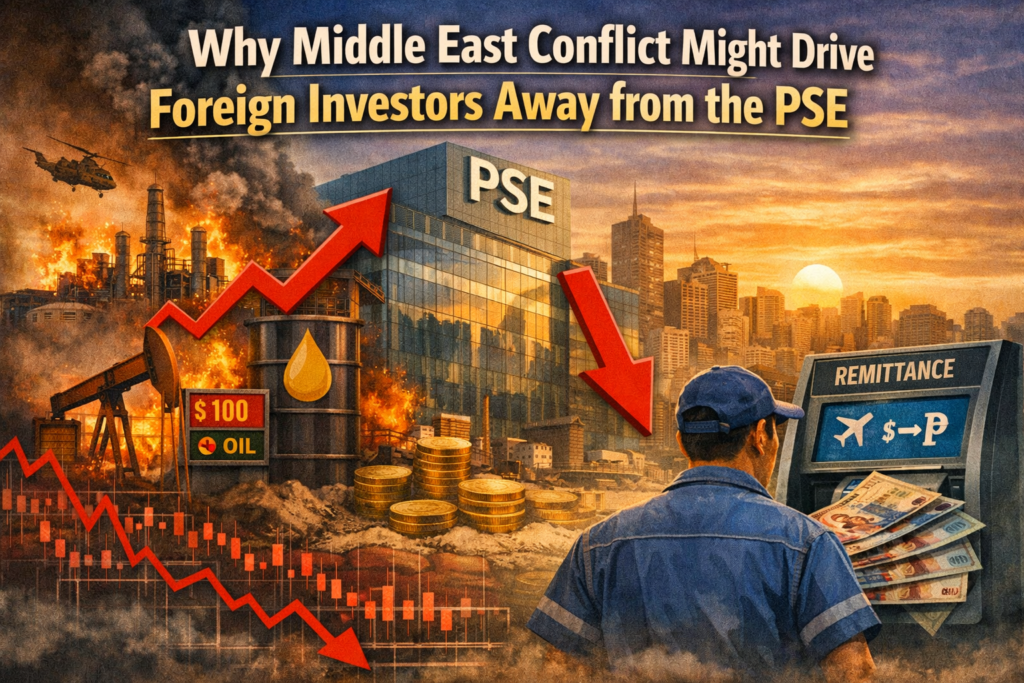
The Philippines may be thousands of miles away from the deserts of the Middle East, but the tremors of conflict between Iran, the United States, and Israel can be felt right here in Manila. Global markets are tightly interconnected, and when geopolitical tensions escalate, investors around the world instinctively shift their strategies. For the Philippine Stock Exchange (PSE), this means facing the harsh reality of risk-off sentiment—a wave of caution that drives foreign capital away from emerging markets and into safer havens.
But the story doesn’t end with investor psychology. Rising oil prices and potential disruptions in Overseas Filipino Worker (OFW) remittances add layers of vulnerability to the Philippine economy. This narrative explores how these global shocks converge, shaping the outlook for the PSE and the broader economy in 2026.
The Flight to Safety: Understanding Risk-Off Sentiment
Whenever conflict erupts in geopolitically sensitive regions, investors worldwide reassess their portfolios. The Middle East, with its strategic oil reserves and volatile politics, has always been a trigger point for global uncertainty.
In times of war, investors typically sell off riskier assets—like stocks in emerging markets—and move into safe havens such as US Treasury bonds, gold, or the US dollar. This is the essence of risk-off sentiment. For the Philippines, which relies heavily on foreign participation in its stock market, the consequences are immediate:
- Capital outflows reduce liquidity in the PSE.
- Valuations weaken as foreign investors trim exposure.
- Volatility spikes, making it harder for local investors to predict market trends.
Even if Philippine companies maintain strong fundamentals, the perception of risk alone can drive foreign investors away. In a globalized financial system, perception often matters as much as reality.
Oil Price Shocks: The Inflationary Domino Effect
The Middle East conflict doesn’t just rattle investor nerves—it directly threatens the world’s energy supply. The Strait of Hormuz, a narrow waterway through which a third of the world’s seaborne oil passes, becomes a flashpoint whenever Iran is involved in military tensions. Any disruption here sends oil prices soaring.
For the Philippines, which imports nearly all of its oil, this is a dangerous scenario. Rising oil prices translate into:
- Higher transport costs, hitting airlines, shipping, and logistics firms.
- Increased electricity bills, as fuel costs ripple through power generation.
- Elevated inflation, squeezing household budgets and reducing consumer spending.
- Peso depreciation, as the country spends more dollars to pay for oil imports.
The PSE feels the pressure across multiple sectors. Airlines and transport companies see margins shrink. Manufacturing firms face higher input costs. Consumer discretionary stocks suffer as households cut back on spending. Even banks may feel the pinch as loan demand slows in an inflationary environment.
Oil shocks are not new to the Philippines, but the scale of disruption tied to a prolonged Middle East conflict could be far more severe than past episodes.
OFW Remittances: A Hidden Vulnerability
Beyond oil, the Philippines has another deep connection to the Middle East: its people. Millions of Overseas Filipino Workers (OFWs) are employed across Saudi Arabia, the UAE, Qatar, and other Gulf states. Their remittances—amounting to billions of dollars annually—are a lifeline for families back home and a stabilizing force for the Philippine economy.
Conflict in the region threatens this lifeline. If instability spreads, OFWs may face job losses, contract disruptions, or even forced repatriation. The ripple effects are profound:
- Reduced remittance inflows weaken household consumption, which drives much of the Philippine economy.
- Lower foreign exchange reserves put pressure on the peso.
- Retail, real estate, and banking sectors—all heavily reliant on remittance-fueled spending—face headwinds.
In short, OFW remittances are not just personal income streams; they are macroeconomic stabilizers. Any disruption in this flow compounds the challenges posed by oil shocks and investor flight.
Why Foreign Investors Might Exit the PSE
Put together, these factors create a triple threat for the Philippine market:
- Geopolitical uncertainty drives global investors toward safe havens.
- Oil-driven inflation erodes corporate earnings and household consumption.
- Remittance risks weaken domestic demand and currency stability.
Foreign investors, sensitive to both real and perceived risks, may decide that the Philippines is too exposed. Even if local fundamentals remain relatively strong, the global narrative of “emerging market vulnerability” can trigger capital flight.
This is the paradox of globalization: the Philippines may not be directly involved in the Middle East conflict, but its economy and stock market are nonetheless caught in the crossfire.
Navigating the Storm: What Investors Can Do
For local investors and policymakers, the challenge is to anticipate and adapt. Some strategies include:
- Diversification: Balancing equity exposure with defensive assets like bonds, gold, or cash.
- Sector monitoring: Paying close attention to inflation-sensitive industries such as energy, transport, and consumer goods.
- Currency vigilance: Watching peso movements against the dollar as oil imports and remittance flows shift.
- Global cues: Tracking oil futures, US Treasury yields, and geopolitical developments as leading indicators of risk-off sentiment.
The PSE may not be able to control global events, but investors can control how they respond to them.
A Year of Heightened Vigilance
The Iran–US–Israel conflict is more than a distant geopolitical drama—it is a direct challenge to the stability of the Philippine economy and stock market. Risk-off sentiment threatens to drive foreign investors away from the PSE. Oil price shocks risk fueling inflation and weakening the peso. OFW remittances, a cornerstone of economic resilience, face potential disruption.
For 2026, the Philippines stands at a crossroads. The global environment demands vigilance, adaptability, and strategic foresight. Investors must brace for volatility, policymakers must prepare for inflationary pressures, and households must navigate the uncertainties of remittance flows.
The lesson is clear: in a world as interconnected as ours, wars fought far away can reshape the financial landscape at home. The Philippine Stock Exchange, like the nation itself, must learn to weather storms that originate beyond its borders.